Role
Project Coordinator / Cross-cultural Communication / Workshop Design
Programme
ICID Vision, Institute of Creative Industries Design, National Cheng Kung University
Guest
Eisuke Tachikawa | NOSIGNER
“Birds have bodies made for flying. Horses have bodies made for running. If so, what is the human form for?”
I encountered this question at the beginning of the anime The World Is Dancing, and I definitely did not expect it to linger in my mind for long.
But later that same day, I listened to Eisuke Tachikawa speak about ADAPTMENT, evolution, and design. Over the days that followed, our conversations moved through evolutional thinking, creativity, language, and the ways designers might learn from the processes through which life itself takes form.
Gradually, the question from the anime felt more like a way of looking, and less like a philosophical opening that’s drifting in the air.
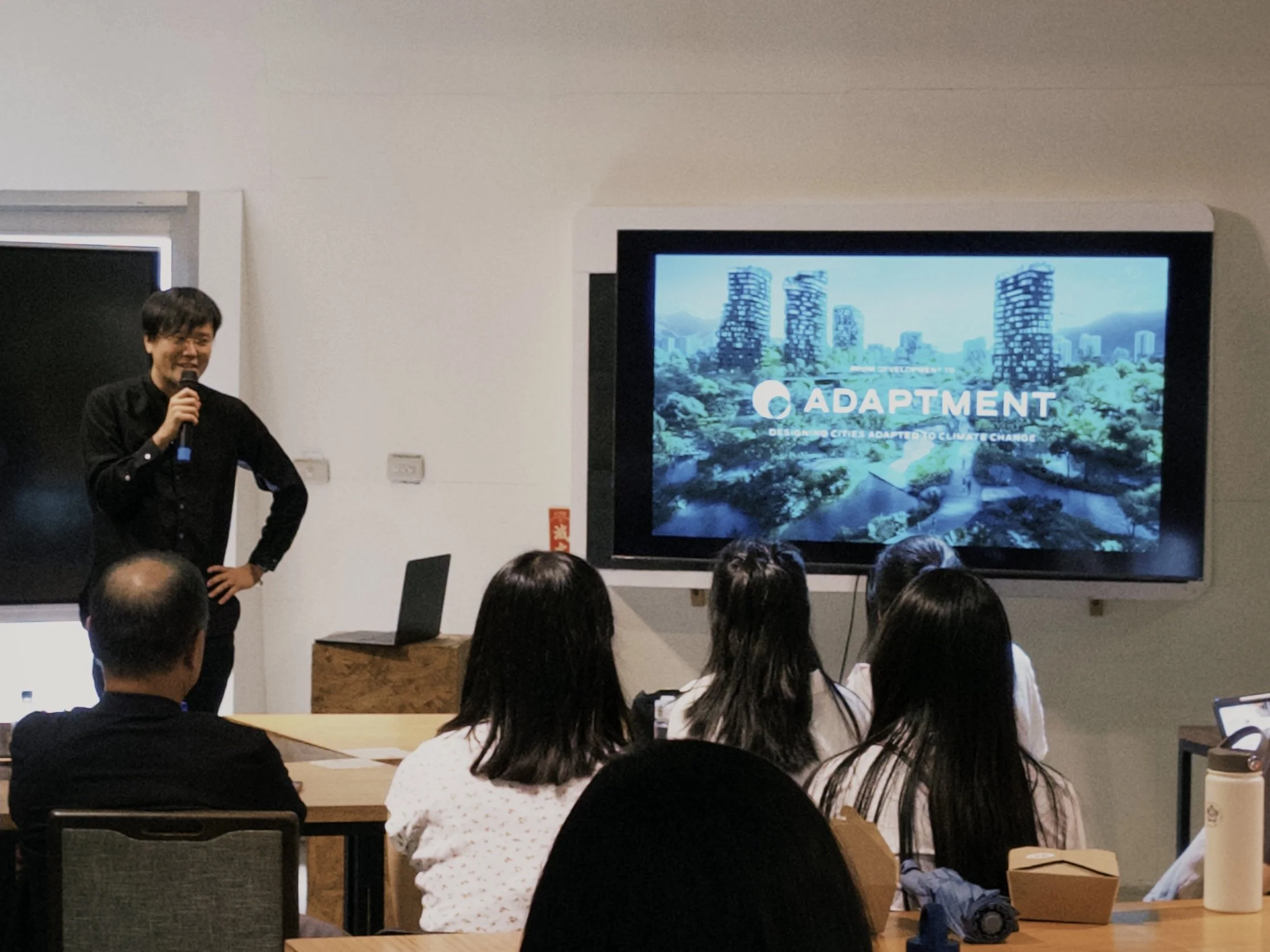
Eisuke Tachikawa introducing ADAPTMENT, one of the encounters that made me rethink how form comes into being.
Perhaps form comes later
From my background, I often think of form as something that is decided. For example, a designer gives an object its form, a writer gives an idea its language, and a body has a shape that enables it to perform a function.
But listening to Tachikawa-san made me wonder whether evolution might reverse — or at least complicate — this relationship.
A wing was not first imagined as the ideal instrument for flight. Life encountered gravity, air, predators, distance, food, climate, and countless other conditions. Across an almost unimaginable accumulation of responses, variations, failures, and continuations, forms emerged.
Seen this way, form might not necessarily be a starting point, but a record of encounters.
A leaf carries within its shape a relationship with sunlight, water, wind, and climate. A bird’s body contains a long history of negotiating with the sky, and perhaps, language does something similar.
The structures of a language, the words a community chooses to keep, the metaphors we use without noticing… Even these contain traces of how people have encountered their world.
This was where evolutional thinking began to connect, for me, with something much larger than biology, design, and creativity.
So I started wondering: What if form is what remains after countless encounters with the world?
The places where something enters
Around the same time, C shared an idea from Charlie Mackesy’s book with me: music often appears where there are cracks in life.
The more I connected it to what I had been learning and reflecting on, the more that single “crack” began to expand in my mind — first into a melody, then chords, perhaps even an orchestra.
A crack usually suggests damage. Something once whole, and now it is not.
But a crack is also an opening.
It is a place where something from the outside can enter, or something from the inside can finally find its way out.
It also reminds me of a very Taiwanese image: tea eggs need cracks in their shells for the flavor to seep in. Of course we would find a philosophical metaphor in food.
Anyway, that thought changed the way I understood another part of The World Is Dancing.
Its opening song “Shusho” by Macaroni Empitsu repeatedly uses the image of wind. An era becomes wind. Music encounters the singer without simply passing through or permanently staying. Sometimes it seems only to invite the singer to sing, allowing them, for a moment, to become like the wind, too.
I love this image of wind because it suggests change without possession, like, an experience does not have to stay forever to change us.
People can pass through our life, cities can change the way we see, and languages can rearrange the categories through which we understand the world, from things measured in microns to the scale of the universe
A piece of music can touch a crack and briefly give something inside us a form.
Then it moves on.
But we are not exactly the same shape afterward.
Design as response
Over the next few days, this question kept echoing when we talked about design.
Design is often described through intentionality: identifying a problem, imagining a solution, and creating the form that answers it. And of course, that ability matters. But evolutional thinking suggests another posture as well.
Before asking, “What should I make?”, perhaps I can start to ask questions like:
What is already happening here?
What pressures, relationships, histories, behaviors, and possibilities are shaping this situation?
What is trying to emerge?
And how might we respond?
At the same time, I kept thinking about the kinds of places I often work in, the communities, cultures, languages, places already dense with relationships and histories.
We are rarely working with an empty surface.
There are already memories, relationships, adaptations, wounds, habits, stories, and forms of knowledge present. Designing in these contexts may be less like placing a new form onto the world and more like participating in an ongoing process of formation.
Perhaps the designer’s work, rather than always being the person who knows the final form, is to notice. Then, to translate, to make relationships visible, and to create conditions in which another form can emerge.
And what, then, is the human form for?
I eventually returned to the question that started all of this.
If the bird’s form is for flying, and the horse’s form is for running, what is the human form for?
I haven’t got an answer yet, and I realised that all along, I have never been interested in finding a single one.
Perhaps what is distinctive about us humans is not one predetermined function, but our capacity to respond.
We encounter the world and translate it through bodies, movements, words, sounds, objects, relationships, and stories.
Something happens or passes through us, sometimes it finds a crack, and sometimes, through that encounter, things that did not previously have a form begins to take one.
It can be a movement, sentence, music, design, or ways of living.
Maybe we are not made for one thing, maybe we are made to respond, transform, and give form to what we encounter — and, in doing so, allow the world to reshape us too.
Perhaps that is why the world keeps dancing.
And why we do, too.
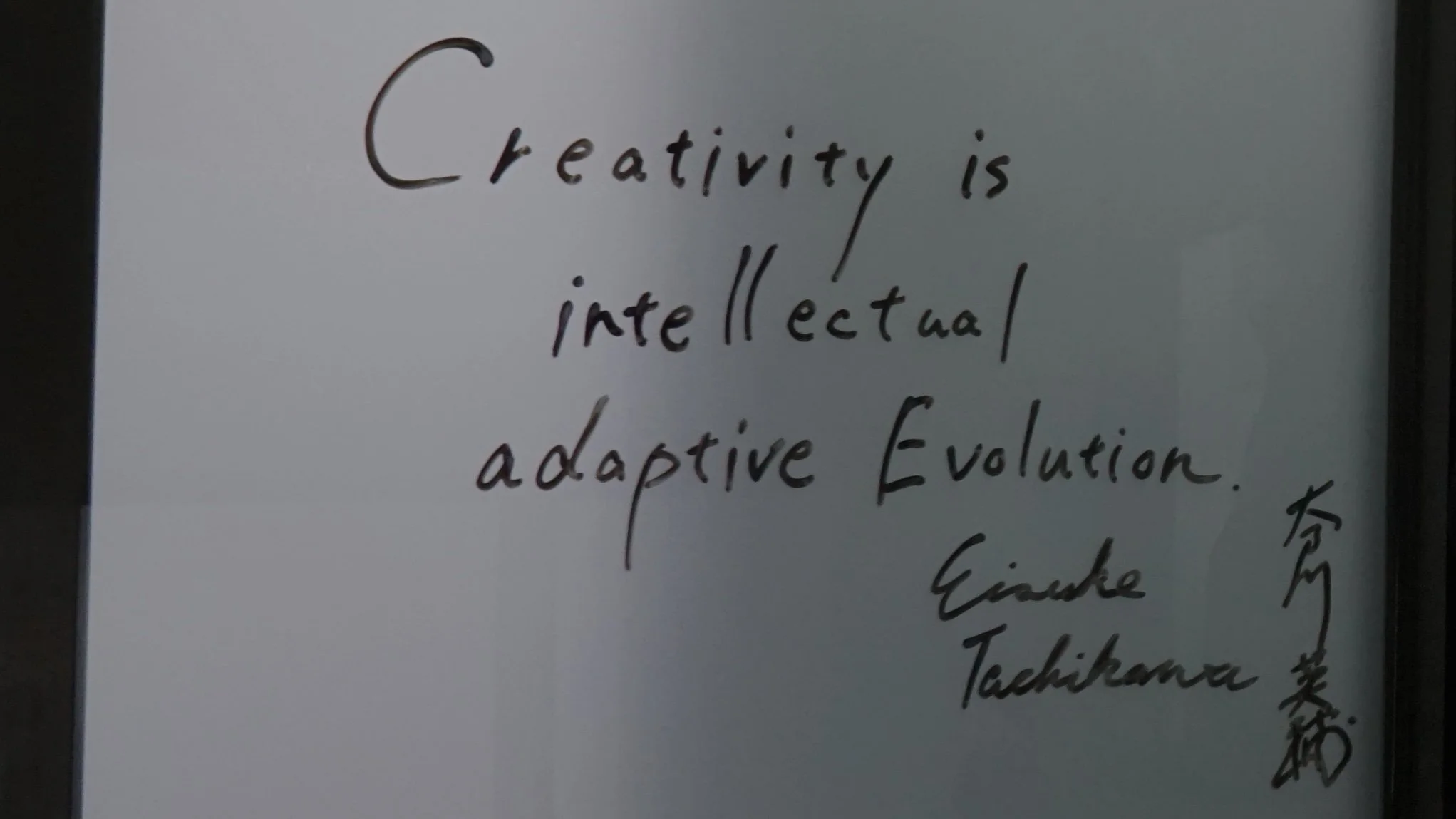
A note from Eisuke Tachikawa: Creativity is intellectual adaptive evolution.
